There was a time when fashion power lived in glossy pages, guarded by gatekeepers who decided what mattered and who didn’t. You wore what they approved. You admired what they published. And somewhere between the pages, ambition quietly reshaped people.
That world is gone.
Or at least—it’s been bought, branded, livestreamed, and seated front row.
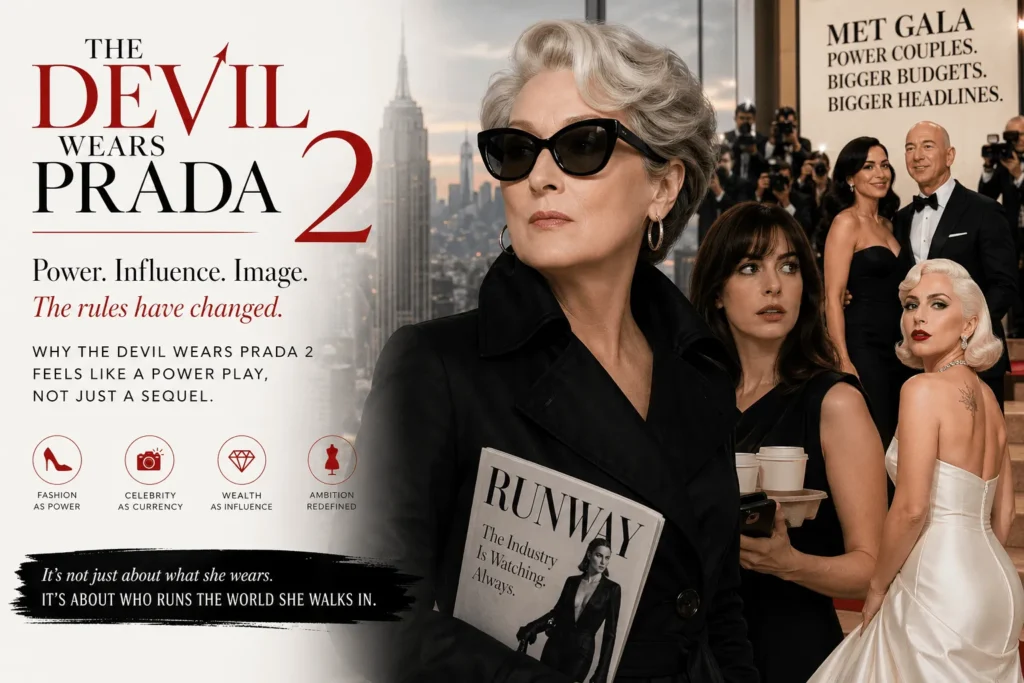
That’s why The Devil Wears Prada 2 already feels less like a sequel and more like a recalibration. The story it returns to isn’t just about hemlines and hierarchy anymore. It’s about influence at scale—where power doesn’t whisper from an editor’s office but echoes through billion-dollar ecosystems.
The New Front Row
Once upon a time, the most important seat in fashion was next to the editor-in-chief.
Now it might belong to whoever funded the event.
The modern fashion spectacle isn’t just curated—it’s capitalized. Mega-events shimmer with couture, but behind the flashbulbs sits a different kind of authority: tech wealth, media dominance, and strategic visibility. Influence has become infrastructural.
And that’s where this new chapter seems to aim its gaze—not at fashion itself, but at the machinery behind it.
Because the question isn’t “What’s in style?” anymore.
It’s “Who gets to decide?”
Miranda in the Age of Algorithms
Miranda Priestly was once terrifying because she controlled access.
Today, access is everywhere. Everyone has a platform. Everyone has a voice. Everyone is, theoretically, visible.
Which makes control harder—and more interesting.
If Miranda returns unchanged, she becomes irrelevant. But if she adapts—if she understands algorithms the way she once understood editors, if she reads cultural shifts the way she once read fabrics—then she’s not outdated.
She’s evolved.
The real intrigue isn’t whether she still commands a room.
It’s whether she can command a system.
The Death of Effortless
There’s something else shifting too—something quieter, but just as powerful.
Effortlessness is no longer believable.
In a world hyper-aware of branding, even “natural” is strategic. Even authenticity is curated. The myth of accidental elegance has been replaced by deliberate minimalism, where every detail is engineered to feel invisible.
That’s why the current aesthetic turn toward restraint—clean lines, controlled silhouettes, Old Hollywood polish—feels less like nostalgia and more like intent.
It says: I don’t need to be loud. I already own the room.
And that energy? It’s pure Prada.
Ambition, Reframed
The original story asked a simple but uncomfortable question: What are you willing to sacrifice to succeed?
But success has changed shape.
It’s no longer just about climbing a ladder—it’s about building the ladder, owning the building, and livestreaming the view from the top.
Ambition now operates in public. It’s visible, performative, and often indistinguishable from identity itself.
So if the sequel is paying attention—and all signs suggest it is—it won’t just revisit ambition.
It will interrogate it.
The Quiet Shift from Fashion to Power
Here’s the truth: fashion was never really the point.
It was always a language—a way to signal belonging, authority, rebellion, or control.
What’s different now is how loudly that language speaks.
Clothes still matter. Image still matters. But they’re no longer the whole story. They’re part of a larger system where money, media, and narrative intertwine.
And that’s the story worth telling in 2026.
Not just who wears the cerulean sweater—
—but who owns the factory that made it, the platform that sells it, and the spotlight that makes it desirable.
Final Stitch
If The Devil Wears Prada 2 leans into all of this—and it appears ready to—it won’t succeed because it reminds us of what we loved.
It will succeed because it understands what has changed.
And more importantly, what hasn’t.
Power still dresses well.
It’s just learned a few new tricks.